
Security · AI
An AI Helped Find a Critical Java Bug in an Hour: What Java4Shell Means for You
18 November 2026 · Nickel Choi
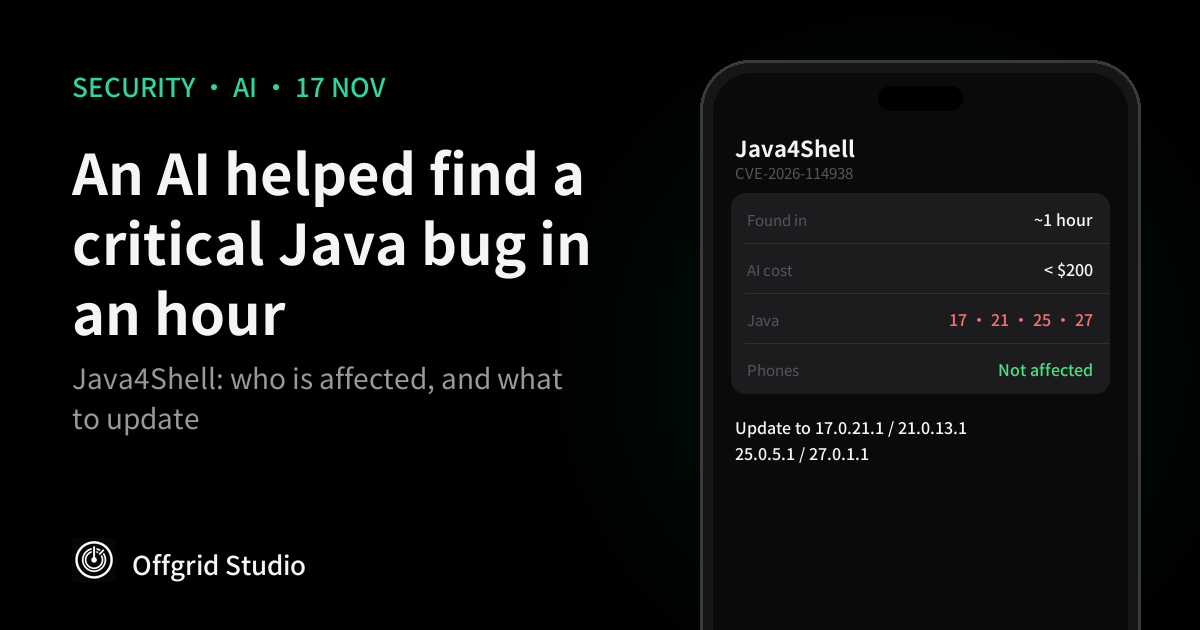
Short answer: a researcher used OpenAI's Codex to find a critical bug in Java in about an hour, for less than $200 in AI costs. It's called Java4Shell (CVE-2026-114938). Your phone isn't affected. Servers running Java 17, 21, 25 or 27 on recent Intel or AMD chips are, and anyone who runs one should update today.
What was found
On 17 November, the security firm Calif disclosed a memory bug in OpenJDK, the engine behind most Java software. It sits in the fast code Java uses to decode Base64, a format websites and apps use everywhere to send data as text. A specially crafted piece of Base64 makes Java write past the end of a buffer. The US cybersecurity agency CISA warned that it "could crash the JVM and allow for unauthenticated remote code execution", meaning an attacker could run their own code without logging in.
Calif says it got code running on several widely used Java products in their default settings, including Keycloak, Jira, Confluence, Jenkins and JFrog Artifactory, without a login. It is keeping those step-by-step attacks private for now. Other researchers had reproduced crashes but not yet code execution, according to Aikido.
The AI part
Researcher Quang Luong pointed Codex at parts of Java he thought were risky. Most early results were, in his word, "slops". He kept prompting. Calif says it then took "an hour to discover the vulnerability, and two more hours to develop the first working exploit", and "the total token cost was less than $200."
Calif's own view is that the best hacker today is a "centaur hacker, part human, part AI". The person knew where to look and wouldn't give up; the AI read huge amounts of low-level code quickly. That combination is now cheap and available to anyone, attackers included. CyberScoop called it "a vulnpocalypse bug worthy of attention", and expect more bugs like it, found faster, in old and trusted code.
Who is affected
- Java versions: 17 (from 17.0.6), 21, 25 and 27, before the November fixes. Java 8 and 11 aren't affected, apart from one Oracle performance build, according to Calif and Aikido.
- Processors: x86-64 chips with AVX-512, such as Intel Ice Lake and Sapphire Rapids server chips and AMD Zen 4 and newer. ARM machines, including Apple silicon Macs, aren't affected.
- Phones: not affected. iPhones don't run Java apps, and Android uses its own runtime, not HotSpot.
Severity scores differ: Calif rates it 9.2 out of 10 (CVSS 4.0). Aikido reports Oracle's score as 8.1 (CVSS 3.1). Either way, it's serious.
If you run Java: what to do
- Find your Java versions. Run
java -versionon each server, and check the Java bundled inside Docker images and tools like Jenkins, which often ship their own. - Update to the fixed release. OpenJDK's fixed builds are 17.0.21.1, 21.0.13.1, 25.0.5.1 and 27.0.1.1. Oracle, Temurin, Corretto, Zulu and Red Hat publish their own builds on their own schedules, so check your vendor's page for the exact number.
- Can't update yet? Calif and Aikido give a stopgap: start Java with
-XX:-UseBASE64Intrinsics, which turns off the fast decoder where the bug is. Check it took effect withjcmd <pid> VM.flags. It's temporary; update when you can. - Start with anything public. Login servers, Jira, Confluence, Jenkins and anything else reachable from the internet first.
If you build apps and use a managed service, such as a hosted backend or CI, check its status page or ask whether it has patched. You probably can't do it yourself.
If you just use the internet
There's nothing to install on your phone or laptop. The risk is that a service you use gets broken into before it patches. You can't control that, but you can limit the damage: use a different password for every service, turn on two-factor sign-in where it's offered, and treat any "unusual sign-in" email from a work tool as real until you've checked.
Questions people ask
Is my iPhone or Android phone affected?
No source we read puts phones in scope. iPhones don't run Java apps, and Android apps run on Android's own runtime (ART), not the HotSpot engine where the bug is. The risk is to servers running Java.
So why should I care if I don't run a server?
Many services you sign in to run on Java, including login systems like Keycloak and work tools like Jira and Confluence. If a company is slow to patch, an attacker could get into the system that holds your account. You can't patch it for them, but strong, unique passwords and two-factor sign-in limit the damage.
Is it being used in attacks yet?
Not as of 18 November. CyberScoop and Aikido both reported no exploitation in the wild, and it wasn't in CISA's Known Exploited Vulnerabilities list. That can change quickly now that the details are public.
Which machines are at risk?
Calif says it needs an x86-64 processor with AVX-512, such as recent Intel Xeon chips or AMD Zen 4 and newer. ARM machines, including Apple silicon Macs and ARM cloud servers, aren't affected.
How we checked this
How the bug was found, the time and cost, the affected processors and products, and the quotes come from Calif's write-up. The exploitation status and context come from CyberScoop. Affected and fixed versions, the scores and the workaround come from Aikido and Safeguard, and the risk statement from CISA's alert. All were read on 18 November 2026. Sources differ on which vendor builds are out, so check your Java vendor directly. We'll update this page if the advice changes.
More from Offgrid Studio
BBC, CNN, Zoom and HSBC Sites Served Malware for a Day: What to Check Now
LiteLLM Was Compromised Twice. What an AI Gateway Holds
Your iPhone Now Watermarks AI-Edited Photos