Security
BBC, CNN, Zoom and HSBC Sites Served Malware for a Day: What to Check Now
17 November 2026 · Nickel Choi
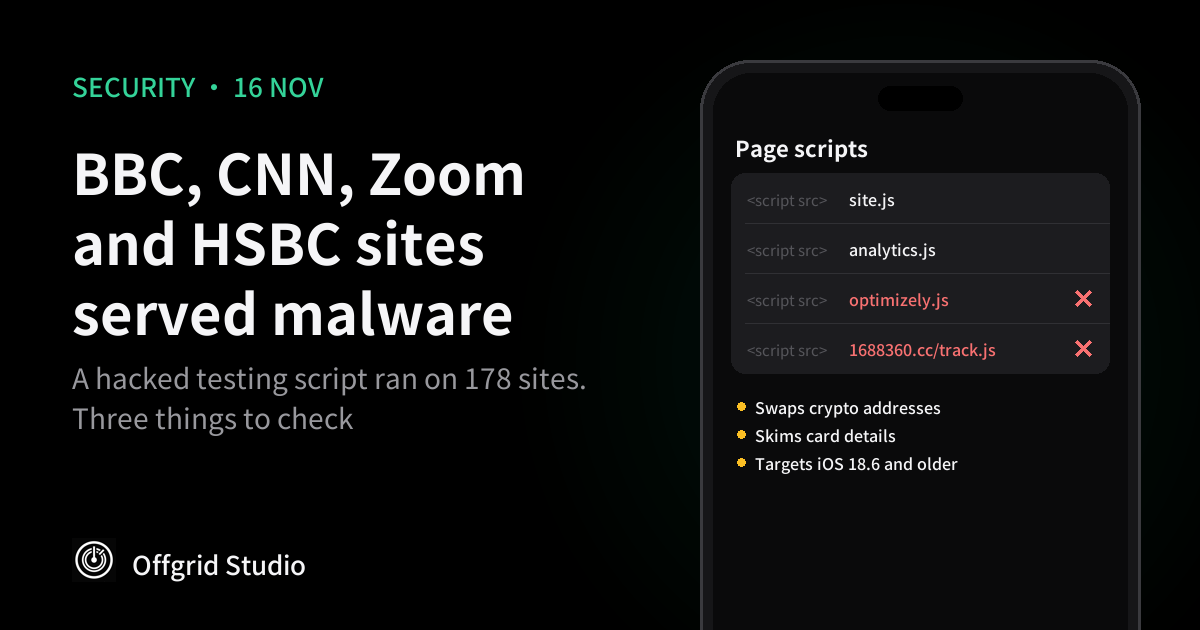
Short answer: on 16 November, malicious code ran for several hours on the websites of 178 organisations, including the BBC, CNN, Zoom and HSBC. If you visited any big site that day, check three things: that your iPhone or iPad is up to date, that any crypto you sent went to the right address, and your card statement.
What happened
Many large websites use Optimizely, a service for testing different versions of a page. To make it work, each site loads a piece of JavaScript from Optimizely into every page.
On 16 November, an attacker got into Optimizely and added their own code to those scripts. Optimizely told BleepingComputer that the attacker "exploited a vulnerability in the Experimentation account signup flow" and used it to add malicious JavaScript to some customer projects. The BBC, CNN and the others weren't hacked themselves. Their sites simply loaded the poisoned code, as they always load Optimizely's.
Security researcher Scott Helme's team at Report URI found it. They checked 1,611 Optimizely scripts and found 188 infected ones, belonging to 178 organisations. The first injection they saw was at 04:21 UTC on 16 November. By 21:52 UTC, only one infected file was left. They say the real number of sites is probably higher, because they could only check the scripts they could find.
Which sites
Report URI and BleepingComputer name, among others: Zoom, the BBC, CNN, Fox News, Salesforce, GitLab, IKEA, Equifax, Air France and KLM, Peacock, Ledger, Change.org, Bitly, UNICEF USA, and HSBC sites in several countries, including Hong Kong, the US, Australia, Singapore and Taiwan. Report URI has the full list.
What the code did
- Swapped crypto addresses. It looked for wallet addresses on the page and in your clipboard and replaced them with the attacker's. Copy an address while one of these pages was open, and you might paste theirs. The attacker's wallets received about $7,040 within roughly nine hours.
- Skimmed cards. It watched forms for a card number, expiry date and security code, and sent them to the attacker. Cards typed into a separate payment box from a provider like Stripe or Adyen were out of its reach.
- Stole cookies and screenshots. It could copy some of the site's cookies and take a picture of the page.
- Attacked older iPhones and iPads. It loaded exploit kits called Coruna and DarkSword, chosen by your iOS version. Report URI says the kit's own notes treat iOS 18.7.3 and later, and 26.3 and later, as patched. On iOS 18.6 or earlier, the page reloaded every 60 seconds to try again, which is a visible sign.
Three things to check
- Your iPhone and iPad version. Go to Settings, General, About and look at the iOS version. iOS 27 is fine. If you're on iOS 18, you need 18.7.3 or later; on iOS 26, 26.3 or later. If Software Update offers anything, install it. If an older device can't update past 18.6, don't use it for banking or crypto.
- Any crypto you sent on 16 November. Compare the address your transfer went to with the one you meant to use. If it's different, contact the exchange or wallet provider straight away, though crypto transfers usually can't be reversed.
- Your card statement. Especially if you paid for something on a big website that day. Report anything you don't recognise to your bank, and ask for a new card if you typed it into one of the affected sites.
If you were logged in to an important account on one of these sites that day, signing out of all sessions and signing back in is a cheap extra step, because some cookies may have been copied.
Why this keeps happening
A modern website isn't one company's code. A news page can load scripts from dozens of other companies: ads, analytics, chat widgets, A/B testing. Each one runs with the same power as the site's own code. If any of those suppliers is compromised, every site using it is compromised at once, and the site's own security team may not notice until a researcher does.
For visitors, that means a trusted name isn't a guarantee. Keeping your devices updated matters more than which sites you visit, and paying through a separate payment box or Apple Pay limits what a skimmer can read.
For anyone who runs a website: list the third-party scripts you load, remove the ones you don't need, and use a Content Security Policy so a page can only load scripts from places you've approved. That wouldn't stop a poisoned script from a supplier you trust, but it can stop it from loading a second payload from an unknown domain, which is how this attack worked.
Questions people ask
Were BBC, CNN or HSBC hacked?
No. Their own systems weren't broken into. They load code from Optimizely, a testing service, and that code was changed by an attacker, so every site that loaded it served the malicious script to visitors.
I'm on iOS 27. Am I affected by the iPhone part?
No. According to Report URI, the exploit kit's own notes say iOS 18.7.3 and later, and iOS 26.3 and later, are patched. iOS 27 is newer than both. Older iPhones and iPads that can't update are the ones at risk.
I paid on one of these sites on 16 November. Is my card stolen?
Not necessarily. The skimmer read card numbers typed into a site's own form fields. Payments entered in a separate payment box from a provider such as Stripe or Adyen were out of its reach. Check your statement anyway and tell your bank about anything you don't recognise.
Is it still happening?
Report URI found the malicious code in only 1 of the 188 infected files by 21:52 UTC on 16 November, and Optimizely says it has fixed the flaw and removed the injected code. Its investigation is ongoing.
How we checked this
The timeline, counts, payload details, iOS versions and site list come from Report URI's investigation by Scott Helme. Optimizely's statement and the independent confirmation of affected sites come from BleepingComputer (16 November 2026). Malwarebytes also covered the attack. Optimizely posts updates at status.optimizely.com. All were read on 17 November 2026. The investigation is ongoing, and we'll update this page if the advice changes.
More from Offgrid Studio
LiteLLM Was Compromised Twice. What an AI Gateway Holds
Got an Apple Spyware Warning? How to Check It's Real and What to Do Next
Black Friday Fake Shops: 7 Checks Before You Pay