Money · AI
Banks Now Say You Pay If Your AI Agent Goes Wrong: What to Check Before You Connect One
19 November 2026 · Nickel Choi
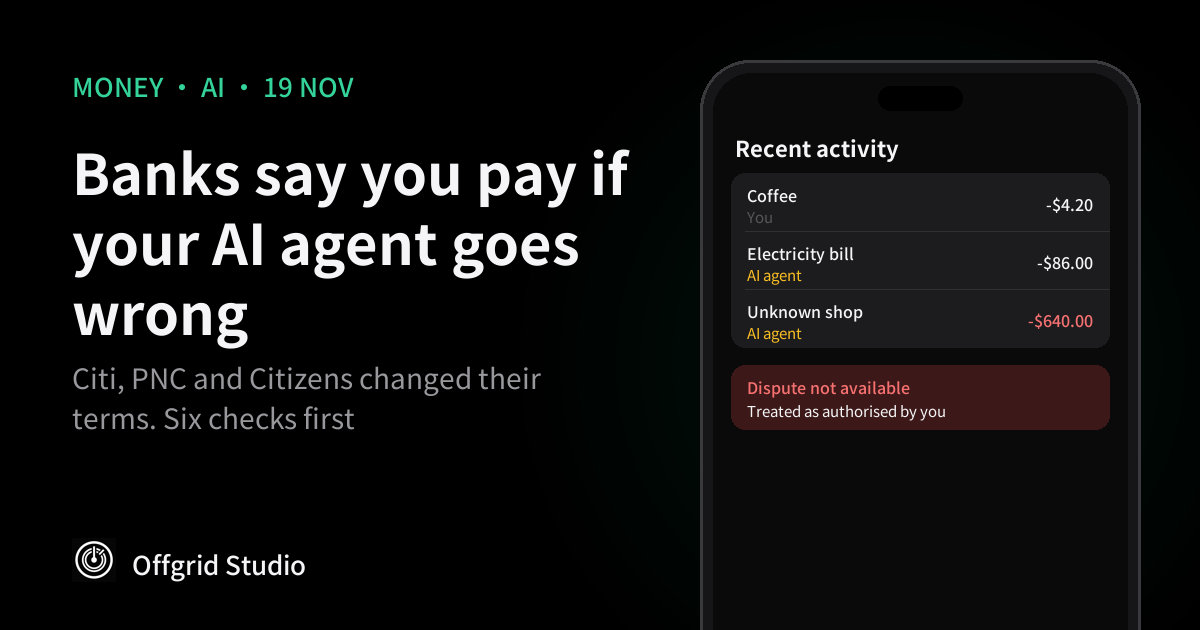
Short answer: Citi, PNC and Citizens have told customers this week that if an outside AI agent uses their bank account, they are responsible for whatever it does, including mistakes, and including what hackers do if the tool is breached. Before you give any AI tool your banking login, read the six checks below.
What changed
AI agents are tools that act for you: they can log in to websites, fill in forms and make payments. Some people have started giving them their banking login to pay bills, move money or shop.
According to TechCrunch, Citi updated its Online User Agreement this week. A Citi spokesperson said customers who give account access to third-party AI agents "are responsible for activities conducted through those agents." TechCrunch reports the terms go further: if the AI tool leaks your login or is hacked, you are responsible for what the hackers do too. PNC changed its terms on 18 November, and Citizens emailed customers a similar warning.
They aren't the first. In October, Bank of America emailed customers asking them not to share their login with "an AI-enabled tool or agent that offers to act on your behalf", adding that "you're responsible for activity resulting from that access" (TechCrunch). CryptoBriefing reports JPMorgan Chase also changed its terms in late October, and Startup Fortune says Wells Fargo's new terms, effective 24 November, treat transactions by AI agents as authorised by you, "including those you did not want or intend."
Why it matters
If someone steals your card, you can usually dispute the charge. That protection depends on the payment being unauthorised. When a bank's terms say an AI agent's actions count as yours, a mistaken or hijacked payment may no longer count as unauthorised, so there may be nothing to dispute.
AI agents can go wrong in ways people don't expect. They misread instructions, pay the wrong amount, or follow hidden text on a web page that tells them to send money somewhere else. Startup Fortune points out that a browser agent reading a malicious page could be steered this way. Under the new terms, that loss could be yours.
Six checks before you connect an AI agent to your bank
- Don't give it your password. If a tool asks for your banking username and password, that's the riskiest way to connect. Your bank's terms almost certainly forbid sharing it.
- Prefer read-only. Budgeting tools that only see your transactions, through your bank's official connection, can't move money. That's a very different risk from an agent that can pay.
- Read your bank's terms first. Search your bank's online agreement for "third party", "agent" or "credentials". If it says you're responsible, believe it.
- Use your bank's own tools where you can. Citi says AI agents it provides don't carry the same extra liability. Built-in bill pay and standing orders are boring but protected.
- Keep a human in the loop. If you do use an agent for shopping or payments, set it to ask before every payment, and use a card or account with a low limit rather than your main account.
- Turn on alerts. Switch on instant notifications for every payment in your banking app, so you see a wrong one in minutes, not at the end of the month.
Already connected one?
Check which tools have access: most banking apps list connected apps and services in their security or privacy settings. Remove any you don't use. If you've ever typed your banking password into an AI tool, change it, and turn on two-factor sign-in if it isn't already on.
Questions people ask
Does this mean I can't use AI with my bank at all?
No. Citi says AI agents it provides itself are covered differently, and tools that only read your transactions through your bank's official connection carry far less risk. The warning is about handing your login, or permission to move money, to an outside AI tool.
What if the AI tool itself gets hacked?
According to TechCrunch, Citi's updated terms say that if a third-party AI tool leaks your credentials or is hacked, you are responsible for what the hackers do with your account.
Doesn't US law protect me from unauthorised transfers?
Normally, yes: rules known as Regulation E limit what you lose from unauthorised transfers. Some writers argue the banks are treating agent activity as authorised by you so those limits don't apply. No court or regulator has ruled on this yet, so don't count on it.
I'm in the UK or Europe. Does this apply to me?
These changes are by US banks, and none of the reports mention other countries. But most banks' terms already say you shouldn't share your login with anyone, so the same caution applies. Check your own bank's terms before connecting an AI tool.
How we checked this
Citi's statement and the PNC, Citizens and hacking details come from TechCrunch (18 November 2026). Bank of America's email comes from TechCrunch (27 October 2026). JPMorgan's change comes from CryptoBriefing, and Wells Fargo's terms and the Regulation E argument from Startup Fortune. None of the reports quotes Citi's new clause word for word, so we've described it as reported. All were read on 19 November 2026. This guide is general information, not legal or financial advice.
More from Offgrid Studio
An AI Helped Find a Critical Java Bug in an Hour: What Java4Shell Means for You
BBC, CNN, Zoom and HSBC Sites Served Malware for a Day: What to Check Now
Black Friday Fake Shops: 7 Checks Before You Pay