
Guide
Record Your Family’s Stories This Christmas: A Guide for iPhone
13 November 2026 · Nickel Choi
Short answer: pick one or two themes, ask open questions, and let them talk. Sit in a small, quiet room with the phone close to the person speaking, and switch on Do Not Disturb. Afterwards, back the recording up in two places and write a few lines about what was said. A transcript makes it searchable and easy to share.
Why Christmas is the right time
For many families, Christmas is the one time of year when everyone is in the same room. Grandparents are there, the photo albums come out, and someone always starts a story that nobody has heard before. Most of those stories are told once and then lost.
You don't need a studio. The film-makers interviewed by Who Do You Think You Are? magazine say a phone is good enough for a family interview, and that audio alone is often more comfortable for older relatives than a camera. What makes the difference is preparation, a quiet room and good listening.
Before the day
- Ask first. Tell them what you'd like to do and why. Rob Perks, the British Library's lead curator of oral history, suggests telling the person that it's up to them what they say, that they don't have to answer every question, and that they can stop at any time.
- Pick a theme. A whole life is too much for one sitting. Childhood, how they met, their first job or moving to a new country are each enough for an hour.
- Make a rough timeline. Write down the dates you already know: where they were born, when they married, when they moved. It helps you ask about the right years and notice when a story skips something.
- Find memory triggers. Old photos, a wedding certificate, a school report or an object from their home bring back details that questions alone won't.
- Write topics, not a script. The Oral History Society advises against over-preparing. A few bullet points keep you on track while the conversation stays natural.
Questions that get people talking
Open questions work best: ones that can't be answered with yes or no. Start easy and save the bigger ones for later, once everyone has relaxed. Some to try:
- Where did you grow up, and what was your street like?
- What's the earliest thing you can remember?
- What were your parents like? And your grandparents?
- What did you do for fun when you were my age?
- How did you two meet?
- What was your first job, and what did you earn?
- What was Christmas like when you were a child?
- Is there a story the family always tells about you?
- What was the hardest time in your life, and how did you get through it?
- What are you proudest of?
- What do you want your great-grandchildren to know about you?
StoryCorps keeps a much longer list, grouped by topic, from growing up to work, marriage and remembering someone who has died.
The best questions often come next. "What happened then?", "What did that feel like?" and "Who else was there?" turn a one-line answer into a story.
Setting up the phone
- Choose a small, soft room. A bedroom or a sitting room with curtains and a sofa echoes far less than a kitchen. Turn off the TV, the radio and anything that hums.
- Put the phone close. Rest it on a cushion or a folded towel between you, nearer the person telling the stories, with the bottom of the phone pointing at them. A phone on a hard table picks up every knock and cup.
- Stop interruptions. Turn on Do Not Disturb or Airplane Mode so a call or notification doesn't break the moment.
- Check the battery and storage. Plug the phone in if you can, and make sure there's space for an hour or more.
- Do a 20-second test. Record a few lines, play them back with headphones, and move the phone if either voice sounds distant.
- Say who, where and when. Start each recording by saying the date, where you are and who is talking. In 30 years, that will matter.
The built-in Voice Memos app is enough to start. Our guide to recording better audio on iPhone covers its settings and where the microphones are.
During the conversation
- Listen more than you talk. Nod rather than saying "yeah" over their words, so your voice doesn't cover theirs.
- Allow silences. A pause often means they are remembering. Wait before asking the next question.
- Ask about details. Names, places, smells, prices and songs make a story come alive.
- Pass them a photo. "Who's this?" can lead to half an hour you didn't plan.
- Keep it short. Forty-five minutes to an hour is plenty. If they get tired, stop and carry on another day.
- Go gently with hard memories. If something is painful, let them decide whether to go on.
Afterwards: don't let it disappear
- Back it up twice. Copy the recording to a computer or an external drive as well as your phone. A single copy on one phone is one dropped phone away from gone.
- Name the file properly. Use the person's name, the date and the theme, such as Grandma-Rose-2026-12-26-childhood.
- Write a short summary. The Oral History Society's Rob Perks points out that after a few interviews you won't remember what was in each one. A few lines about the topics and names covered saves hours later.
- Give them a copy. It's their story. Ask before sharing it beyond the family.
Turning the recording into text
An hour of audio is hard to share. Few people will listen to all of it, and you can't search it for the moment Grandpa mentioned the farm. A transcript fixes that. You can search it, copy quotes into a family tree or photo book, and send the best five minutes to a cousin.
- Label who is speaking. With two or three people talking, a transcript without names is hard to follow.
- Check names and places. Speech-to-text often gets family names, old street names and village names wrong. Fix them while the conversation is fresh.
- Keep the audio. The transcript tells you what was said. The recording keeps their voice, their laugh and their accent.
- Think about where it goes. Family stories can include health, money and old arguments. Before you upload a recording to a transcription service, check what it does with recordings. Our look at what transcription apps do with your recordings explains what to look for.
If the recording has a lot of room echo or a noisy background, cleaning it first makes the transcript more accurate. Our audio clean-up guide explains how.
Questions people ask
Audio or video?
Audio is simpler and often more relaxed, because there's no camera pointing at anyone. Video keeps faces and gestures, but needs good light, a stand for the phone and far more storage.
Do I need an external microphone?
Not for one family interview. A phone close to the speaker in a quiet room is good enough. If you plan to record many people, a small clip-on microphone is worth buying.
What if they speak another language or a dialect?
Record in whatever language they're most comfortable in. Stories told in someone's first language are usually richer. Check which languages your transcription tool supports before the day.
Is it all right to record without telling them?
No. Apart from the law, which varies by country, a secret recording isn't a family history. Ask, explain what you'll do with it, and record only when they agree.
Tools we make for this
We make OffgridScribe and OffgridVox, so treat this as a disclosure as well as a suggestion. We built them for recordings that shouldn't leave the phone, and family stories are one of those.
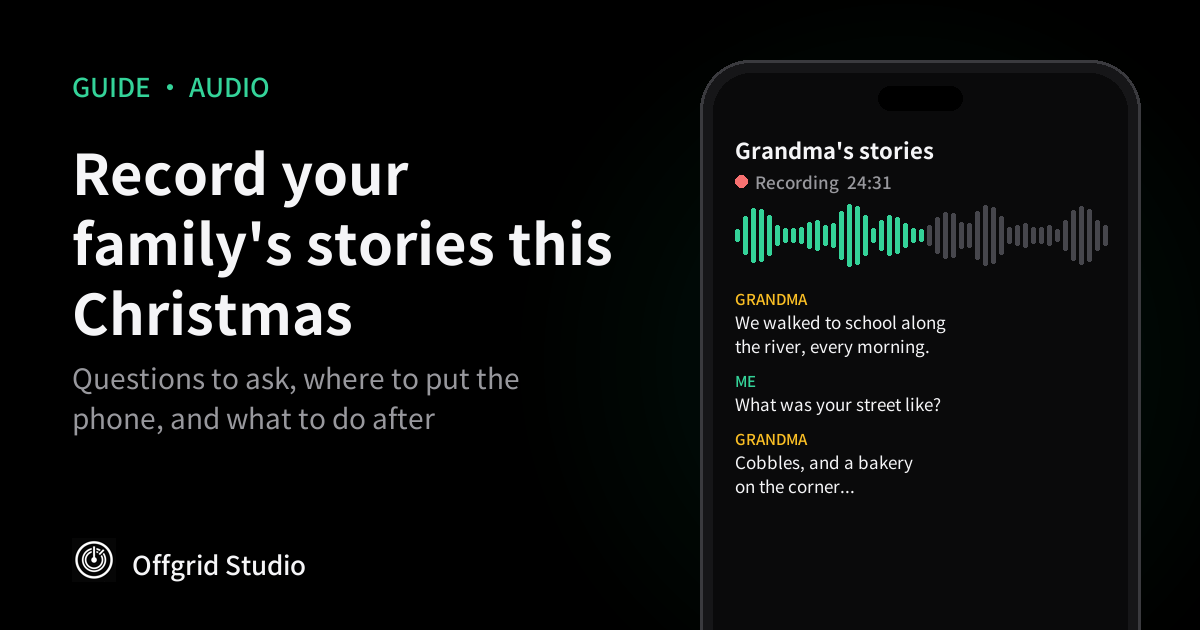
- OffgridScribe records and transcribes on your iPhone, with nothing uploaded. It labels speakers automatically, and you can rename them to "Grandma" and "Me" afterwards. It transcribes 12 spoken languages, including Cantonese, and exports to PDF, Word or plain text. On iOS 18 or later you can start recording from the Lock Screen, so you don't have to fiddle with the phone once the story starts.
- OffgridVox removes room echo and background noise from a recording on the phone, which helps when the only free room was the kitchen.
Both are one-time purchases, not subscriptions, and both have a free version to try first. From 27 November to 1 December they are on sale for Black Friday: OffgridScribe Premium at £16.99 instead of £24.99, and OffgridVox Premium at £9.99 instead of £14.99. Voice Memos and a notebook work too. The stories matter more than the app.
How we checked this
The advice on permission, listening and writing summaries comes from Rob Perks of the British Library and the Oral History Society, in his tips for the National Lottery Heritage Fund. The advice on phones, audio versus video, timelines, scripts and room choice comes from Who Do You Think You Are? magazine's guide to interviewing relatives, which quotes professional film-makers and the Oral History Society. The question ideas draw on StoryCorps' Great Questions. All three were read on 13 November 2026. App features and prices come from our own app pages; Black Friday prices depend on Apple applying the scheduled price change.
More from Offgrid Studio
How to Record Better Audio on iPhone
Transcribe, Summarize and Label Speakers on iPhone
How to Remove Echo From a Recording on iPhone